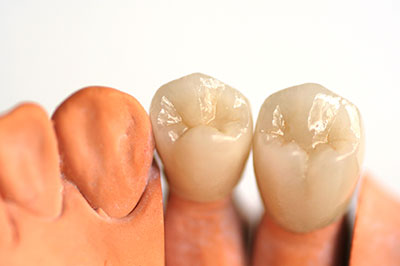
Once commonly referred to as, “porcelain jackets,” today’s all-ceramic crowns are fabricated from advanced generations of aesthetically appealing, lifelike materials affording strength and durability approaching that of tradition metal and porcelain fused to metal crowns (PFM).
When a tooth requires a full coverage restoration to rebuild its structural integrity and appearance, how good the crown will look and how well it will withstand the forces of oral function are major considerations in choosing the type of crown. In the past, only metal crowns or ones fabricated out of porcelain fused to an underlying substructure of metal offered the strength required to bite and chew without breaking. While porcelain fused to metal crowns to this day remain a popular choice for strong, attractive and long-lasting restorations to rebuild teeth that are damaged, decayed, misshapen, worn down, undersized, or have had a root canal procedure, there are some drawbacks. For one thing, the thin metal margin at the collar of a PFM crown may be visible at the gumline (especially in the presence of receding gums). Also, due to the presence of an underlying metal shell, porcelain fused to metal crowns do not come close to handling light in the same way as natural tooth structure or dental ceramics.
Advantages of Ceramic Crowns
While the trade off between appearance and strength used to mean that porcelain or all-ceramic crowns looked better but did not have the strength and durability of porcelain fused to metal crowns that is no longer the case. All-ceramic crowns are not only capable of producing incredibly lifelike results, but thanks to the range of materials available today, all-ceramic crowns are stronger and more reliable than ever before.
Some of the advantages of all-ceramic crowns include:
With the range of engineered dental ceramics available today, which material is selected for crown fabrication depends upon the location of the tooth, the stresses on that tooth and the esthetic requirements of the case. Certain all-ceramic crowns are more suited for back teeth, while others are able to fulfill the aesthetic requirements presented by a front tooth. Some of the all-ceramic crowns used today include Feldspathic porcelain crowns, Empress crowns, Procera crowns, Lava crowns, Zirconia crowns, and Emax crowns.
While a dental filling is designed to replace a portion of a decayed or damaged tooth, a dental crown offers full coverage to restore the tooth’s entire outer surface. A well-fitting dental crown not only protects and strengthens the underlying tooth structure, but it also restores the tooth’s appearance and function.
The procedure for getting an all-ceramic crown is much like the procedure for getting any other type of crown. In all cases, the tooth needs to be prepared, an impression taken, and a permanent crown cemented into place. A single all-ceramic crown can typically be fabricated over the course of two visits. However, with CAD/CAM technology, a same-day crown can be fabricated from start to finish in a single visit. With the first approach, a temporary crown is typically worn until the second visit, when the permanent restoration is placed. As with every treatment plan, our office will explain your best options in care.
As the name implies, a temporary crown is only worn for a short time until the permanent crown is placed. A temporary crown is typically fabricated from durable tooth-colored dental acrylics. While designed to protect the underlying tooth between appointments, and until your new permanent crown gets placed, a temporary crown is also fabricated to look like a natural tooth and maintain the look of your smile.
While you should feel better having an attractive and functional tooth to restore your smile, your tooth may feel a little sensitive following treatment. This initial sensitivity will subside. We take great care to make sure your new restoration looks great, fits well, and your bite is perfect. However, we’re always happy to make any minor adjustments to ensure your comfort.
With some exceptions, teeth with root canal procedures are typically restored and protected from further damage with a full-coverage crown. Based on what’s best for your smile, our office will recommend the most appropriate restoration to maintain the health and longevity of your tooth following a root canal procedure.
A dental crown is a long-term restoration that, if properly cared for, can serve you well for many years to come. Once your new crown is placed, it requires the same brushing, flossing, and periodic checkups as your natural teeth. Avoid biting your fingernails and chewing on hard or sticky objects such as ice, pencils, or taffy, which can damage or loosen your crown. Remember, clenching and grinding your teeth puts excessive pressure on both natural teeth and dental restorations. Unless treated, this habit can compromise the longevity and integrity of your dental work, including crowns.
Although your new all-ceramic crown restores the tooth's strength, form, and function, you can still develop dental disease in the absence of proper care. To prevent gum disease and tooth decay, it’s essential to brush and floss as instructed and see our office for routine checkups, cleanings, and care.
How long a dental crown lasts depends on various factors, including your level of oral care, diet, and oral habits. While the standard answer is that dental crowns can last anywhere from 5 to 15 years, existing literature confirms that most dental crowns remain in place at 15 to 20 years.
At the office of William L. Krell, DDS, MAGD, we strive to provide the highest quality of care to address all your dental needs. Once we’ve had the opportunity to examine your smile, we can give you a clear picture of any dental issues that are present, along with a quote for how much treatment will be. The cost of dental crowns can vary a little, depending on the type of crown and its location. Our goals are to provide the highest quality of care and help patients begin treatment without additional financial stress or delay. We’re always happy to answer all your questions on dental insurance coverage, available financing, and payment plans.
Coverage for all-ceramic crowns depends on your dental insurance plan. Today, many dental plans provide some level of coverage for all-ceramic crowns. At the office of William L. Krell, DDS, MAGD, we work with patients to optimize their dental benefits and get the care they need to maintain healthy and beautiful smiles!
A ceramic crown is a full-coverage dental restoration made from advanced, metal-free ceramic materials designed to restore a damaged or weakened tooth. It recreates the outer form of the tooth and protects remaining structure while allowing normal chewing function. Because it is manufactured to mimic enamel, a ceramic crown restores both appearance and performance.
Unlike metal-based or porcelain-fused-to-metal crowns, all-ceramic restorations do not have a metal substructure, which improves translucency and eliminates a dark margin at the gumline. Modern ceramics are engineered to balance toughness with lifelike optics, so they can be selected for different areas of the mouth based on strength and esthetic needs. This combination of biocompatibility and esthetics makes ceramic crowns a preferred choice when appearance is important.
A ceramic crown is recommended when a tooth has lost substantial structure from decay, fracture, or previous restorations and a simple filling would not restore predictable strength or longevity. Crowns fully encase the remaining tooth, preventing splitting and restoring proper chewing surfaces and contacts with neighboring teeth. They are often indicated when a tooth must withstand significant bite forces or when most of the natural tooth tissue has been removed.
Crowns are commonly placed after root canal therapy because treated teeth can become more brittle over time and may be prone to fracture without full coverage. They are also the restoration of choice for teeth that will support bridges or replace missing teeth on implants, where precise shaping and complete coverage are required. When both form and cosmetic appearance must be addressed together, especially in visible areas, an all-ceramic crown provides a conservative and natural-looking solution.
Material selection depends on the tooth's position, the amount of remaining tooth structure, the forces of your bite, and the desired esthetic outcome. Posterior teeth typically require ceramics with higher fracture resistance, while anterior teeth demand materials with superior translucency and shade-matching capabilities to blend with adjacent teeth. Your dentist evaluates functional and cosmetic priorities and then recommends the ceramic that best balances strength and appearance for your situation.
Common options include lithium disilicate for strong, glassy esthetics; leucite-reinforced porcelain for conservative preparations and fine aesthetics; and zirconia in monolithic or high-translucency forms for exceptional strength or improved translucency. Each material involves trade-offs between toughness, polishability, and optical properties, and those trade-offs are discussed so you understand how the chosen ceramic will perform. Personalized planning ensures the selected material supports predictable function and a natural appearance.
The process generally begins with a comprehensive evaluation and imaging to assess tooth structure, occlusion, and surrounding tissues, followed by conservative tooth preparation to shape the remaining structure for optimal fit. Your dentist will take precise impressions or digital scans that capture margin details and shade information to guide fabrication, and a temporary restoration may be placed while the final crown is made. Attention to marginal fit and occlusal relationships is prioritized to ensure long-term comfort and function.
When appropriate, the office of William L. Krell, DDS, MAGD uses contemporary techniques such as digital impressions and CAD/CAM milling to increase accuracy and streamline treatment. Throughout fabrication the team verifies shade, shape, and bite so the finished crown integrates smoothly with your smile and opposing dentition. Final cementation includes careful adjustment and polishing to achieve a natural appearance and comfortable chewing contacts.
Ceramic crowns are durable restorations that can last many years when they are properly planned, fabricated, and maintained, but longevity varies with oral habits, occlusal forces, and oral hygiene. Regular dental checkups allow your dentist to monitor crown margins, contact points, and surrounding gum tissue for early signs of wear or complications. Avoiding habits that place excessive force on teeth, such as nail-biting or opening objects with your teeth, helps preserve the restoration.
Good oral hygiene, including twice-daily brushing and daily interdental cleaning, reduces the risk of decay at the crown margin and supports healthy gums that maintain a stable seal. If you clench or grind your teeth, your dentist may recommend a protective night guard to mitigate excessive forces and reduce the risk of fracture. Prompt attention to discomfort, loosening, or changes in bite helps address issues early and extend the useful life of your crown.
Yes, ceramic crowns are commonly used as the visible prosthetic tooth over dental implants and as individual units in fixed bridges where a lifelike appearance is desired. When restoring an implant, the crown is designed to connect precisely to the implant abutment and withstand occlusal forces while matching adjacent natural teeth in shade and form. For bridges, ceramic crowns on abutment teeth provide stable support and seamless integration with pontics that replace missing teeth.
Design considerations differ slightly between implant and tooth-supported restorations because implants lack a periodontal ligament and distribute forces differently, so material choice and occlusal planning are critical. Your dentist evaluates opposing dentition, implant position, and esthetic demands to recommend the most appropriate ceramic and connector design. Skilled laboratory techniques or in-office milling ensure accurate fit and predictable function for implant and bridge restorations.
All-ceramic crowns are metal-free and are an excellent option for patients with metal allergies or those who prefer a fully biocompatible restoration. Because they do not rely on a metal substructure, ceramic crowns avoid potential corrosion and eliminate the risk of metal-related adverse tissue responses. Their favorable tissue compatibility also reduces the chance of a dark margin at the gumline that can occur with some metal-based restorations.
Biocompatibility is one of several factors considered when recommending a restoration, and your dentist will review your medical and dental history as part of treatment planning. For patients with known sensitivities, selecting a ceramic solution can provide a reliable restorative outcome without introducing metals into the oral environment. This approach supports comfortable soft tissue response and an esthetic result.
All-ceramic crowns mimic the light-transmitting properties of natural enamel more closely than metal-based restorations, producing depth, translucency, and surface texture that look convincing under a range of lighting conditions. Because ceramic systems can be layered or stained and glazed with precision, they allow for nuanced shade matching that blends with adjacent teeth and resists visible discoloration over time. The absence of metal eliminates the gray line at the gum margin, which helps maintain a natural gum-to-tooth transition.
Contemporary ceramic chemistry and laboratory techniques permit highly individualized characterization of each crown, so subtle variations in color and translucency can be reproduced for a harmonious smile. When conservative preparations are possible, some ceramics let us preserve additional healthy tooth structure while achieving exceptional esthetics. This combination of minimally invasive preparation and lifelike optics makes ceramic crowns particularly attractive for teeth in the smile zone.
Yes, the practice offers same-day ceramic crown options in appropriate cases by using digital impressions and in-office CAD/CAM milling systems to fabricate restorations on-site. This workflow can reduce the number of visits required and eliminates the need for a temporary crown in many situations, while still allowing careful shade selection and occlusal adjustment. Same-day crowns are ideal when clinical conditions permit a single-visit restoration without compromising fit or esthetics.
Not every situation is suitable for immediate milling; complex cases, extensive esthetic requirements, or laboratory-fabricated layering may still require traditional workflows. During your consultation we will determine whether a same-day option is clinically appropriate and explain the advantages and limitations of in-office milling. Our goal is to match technology to clinical needs to produce reliable, natural-looking results.
While ceramic crowns are predictable restorations, potential issues can include marginal leakage leading to decay, crown fracture or chipping, sensitivity after placement, and problems with fit or occlusion that affect comfort. Early detection through regular dental exams allows for conservative interventions such as repair of minor chipping, adjustment of occlusion, or treatment of recurrent decay at the margin. Proper planning and material selection reduce the likelihood of many complications.
If a crown becomes loose or damaged, prompt evaluation is important to protect the underlying tooth and surrounding tissues. Endodontic treatment may be necessary when a tooth beneath a crown shows signs of irreversible pulp damage, and replacement of a compromised restoration can restore function and esthetics. Clear communication about post-treatment care and routine monitoring supports predictable outcomes and timely management of concerns.

Get in touch with us today!