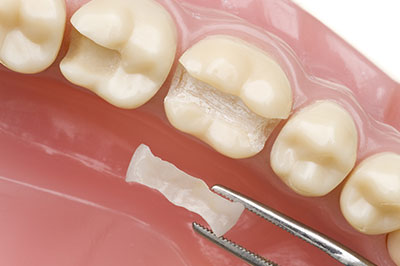
Dental inlays and onlays offer an excellent alternative to “direct” amalgam or composite fillings to restore teeth that have sustained some damage, but not enough to require a full coverage crown. While “direct” fillings such as dental amalgam and composite fillings are placed immediately after the decay or damage is removed and the tooth is prepared, inlays and onlays are known as “indirect” fillings. This means that they are fabricated outside of the mouth prior to final bonding or cementation.
While in the past, many inlays and onlays were caste from gold; today’s dental inlays and onlays are typically custom made of either the highest grade of dental porcelain or composite resins. In addition to providing an exact match to the color of tooth for a cosmetically pleasing result, inlays and onlays have the distinct advantages of being more durable than other fillings, preserving more underlying tooth structure and actually strengthening the tooth so that it can bear up to 50 to 75 percent more chewing forces.
Inlays and onlays only differ from each other in the amount of tooth structure they cover. An inlay is fabricated when the replacement of tooth structure does not require coverage of any cusp tips. If the damage from decay or injury is more extensive and involves more of the tooth’s chewing surface, including one or more cusp tips, an onlay is required.
Both inlays and onlays are fabricated outside of the mouth based upon the exact specifications provided by an impression of the prepared tooth. The final inlay or onlay is then custom made by either a dental laboratory or in-office with a same day system.
Inlays and onlays are laboratory- or CAD/CAM-fabricated restorations that repair damaged tooth structure while conserving as much natural enamel and dentin as possible. An inlay fits within the cusps on the chewing surface of a posterior tooth, whereas an onlay extends over one or more cusps and may cover a larger portion of the biting surface. Both are bonded to the tooth using adhesive resin systems that help restore strength and function with a precise marginal fit.
By contrast, direct fillings are placed and shaped inside the mouth and are typically recommended for smaller defects. When a defect is too large for a direct filling but not extensive enough to require full crown coverage, an inlay or onlay often provides a more durable and conservative solution. The choice among filling, inlay/onlay, and crown depends on the amount of remaining tooth structure, occlusal forces, and long-term prognosis.
Inlays and onlays are recommended when a cavity or fracture involves more tooth structure than a conventional filling can reliably restore but the remaining structure is sufficient to avoid full-coverage crown preparation. They are particularly useful when preserving healthy enamel and dentin is a clinical priority and when a restoration needs to resist significant chewing forces. Dentists also consider patient-specific factors such as bite dynamics, bruxism, and the tooth's location.
These restorations are frequently chosen for posterior teeth that require reinforcement after endodontic therapy or to replace large, failing restorations with recurrent decay. When esthetics are important for a visible posterior tooth, tooth-colored ceramic or composite onlays can provide a lifelike appearance while maintaining chewing efficiency. Ultimately, the clinician balances structural preservation, function, and esthetic goals to determine the best option.
Common materials include high-quality ceramics or porcelain, indirect composite resins, and gold alloys. Ceramics and porcelain are favored for their ability to mimic natural tooth translucency and color while offering strong wear resistance and biocompatibility. Indirect composites provide a tooth-colored, more economical option with acceptable strength, and gold remains a durable choice with excellent longevity and gentle wear characteristics against opposing teeth.
The material selection depends on functional demands, esthetic priorities, and the tooth's position in the mouth. Ceramic restorations excel in appearance and stain resistance, while gold can be preferable in high-load situations where ultimate durability is required. Your dentist will explain the tradeoffs and recommend the material that best matches the tooth's needs and your long-term goals.
The process typically begins with a comprehensive examination and imaging to assess the tooth and surrounding structures. The tooth is prepared by removing decay and shaping margins to create a stable, clean foundation; impressions are then taken using a digital scanner or traditional materials depending on the clinical workflow. If a laboratory approach is used, a temporary restoration may be placed while the permanent piece is fabricated, and if same-day CAD/CAM is available, the restoration can often be designed and milled in a single visit.
At the placement appointment the clinician checks fit, contacts, and shade before bonding the restoration with advanced adhesive systems to create a durable union with the remaining tooth. After final adjustments and polishing, bite and function are verified to ensure patient comfort. Mild sensitivity for a few days is possible, but most patients resume normal eating shortly after treatment with routine post-operative care instructions.
The primary advantage of inlays and onlays is conservation of natural tooth structure while providing a strong, well-fitting restoration that can protect against fracture and recurrent decay. They offer excellent esthetics when made from ceramic materials and typically produce smoother margins and more accurate occlusal relationships than large direct fillings. Bonded restorations can also reinforce remaining tooth structure and reduce the risk of catastrophic failure associated with weakened cusps.
Limitations include the need for sufficient remaining tooth to support the restoration and the potential for additional appointments if laboratory fabrication is required. In cases of extensive structural loss or very thin remaining walls, a full-coverage crown may be the more predictable long-term solution. Your dentist will evaluate the tooth and discuss practical expectations, including when an onlay should be escalated to a crown for greater protection.
With proper material selection, precise bonding, and good oral hygiene, inlays and onlays can provide many years of reliable service—often well over a decade. Key factors that influence longevity include the type of material used, the quality of the fit and bond, the level of occlusal stress the tooth experiences, and the patient's maintenance habits. Regular dental checkups allow your clinician to monitor margins and adjacent tooth health and to address early signs of wear or recurrent decay.
Behavioral factors also play a role; habits such as bruxism, chewing hard objects, or using teeth as tools increase the risk of fracture or premature wear. Protective measures like a nightguard for grinders and avoiding high-risk chewing behaviors can extend the life of restorations. Timely professional care and prompt attention to any changes in comfort or function help preserve both the restoration and the underlying tooth.
Yes, inlays and onlays are often an excellent restorative choice for teeth that have undergone endodontic treatment because they can restore structure while preserving remaining tooth substance. After a root canal, a tooth may be more brittle and benefit from an onlay that protects one or more cusps from fracturing. The decision depends on the extent of structural loss, the presence of a post or core, and the tooth's occlusal demands.
In some instances, particularly when significant coronal structure is missing, a full-coverage crown may still be necessary to provide optimal protection. Your dentist will evaluate the treated tooth to determine whether an inlay or onlay will provide sufficient reinforcement or if a crown would offer a more predictable long-term outcome. The goal is to balance conservation with durable protection against future breakdown.
The procedure is performed under local anesthesia so patients typically experience minimal discomfort during preparation and placement. Modern anesthetic techniques and gentle handling of tissues minimize intraoperative pain, and many people report that the process is comparable to receiving a large filling. If a temporary restoration is needed, it helps protect the tooth between appointments and reduces sensitivity.
After bonding, some patients notice mild, short-term sensitivity to temperature or chewing that usually resolves within days to weeks. Over-the-counter analgesics and avoiding very hard or hot foods for a brief period can help manage symptoms. If persistent or worsening pain occurs, you should contact the dental office for evaluation to rule out issues such as bite discrepancies or recurrent disease.
Digital scanning improves patient comfort and accuracy by eliminating traditional putty impressions and providing high-resolution 3D data for restoration design. When a practice is equipped with chairside CAD/CAM systems, restorations can be designed, milled, and polished in a single visit, eliminating the need for temporary restorations and reducing total treatment time. Even when a laboratory fabrication workflow is chosen, digital files streamline communication and can enhance fit and consistency.
Whether fabricated in-office or by a trusted dental lab, the essential factors for success remain precise preparation, accurate occlusal adjustment, and meticulous bonding. Digital workflows are a powerful tool to achieve those outcomes, but clinical skill and adhesive protocols are equally important for long-term performance. Your dentist will explain the workflow option best suited to your case and expected timeline.
Caring for an inlay or onlay mirrors care for natural teeth: brush twice daily with fluoride toothpaste, floss daily, and maintain routine professional cleanings and examinations. Avoid chewing on hard objects, reduce habits that place excessive force on posterior teeth, and discuss a nightguard with your dentist if you grind or clench your teeth. Regular checkups allow early detection of marginal issues and timely maintenance to preserve the restoration's integrity.
Contact the office of William L. Krell, DDS, MAGD if you experience persistent sensitivity, a change in bite, visible chipping, or any sensation that the restoration feels loose or uneven. Prompt evaluation helps identify problems such as marginal breakdown, recurrent decay, or occlusal interference and enables conservative repairs before more extensive treatment is needed. Early attention supports better outcomes and helps protect your natural tooth for years to come.

Get in touch with us today!