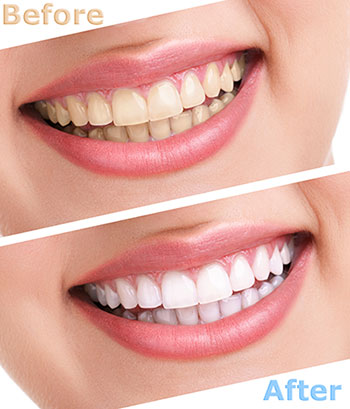
A teeth whitening procedure or bleaching simply refers to any process that will make the teeth appear whiter. It is considered a non-invasive procedure that is designed to whiten and brighten teeth that are stained, discolored, darkened, or yellowed. First introduced to the public in the 1980’s, the popularity of teeth whitening products and procedures has soared. According to a survey conducted by the American Academy of Cosmetic Dentistry, when respondents were asked, “What would you like to improve most about your smile?” The most common response was: whiter and brighter teeth.
How white a tooth appears depends upon how light is reflected and scattered off the enamel, the outermost layer of the tooth. Teeth can look dark or discolored for a variety of reasons, with an imperfect appearance the result of outer surface stains or discoloration from within the tooth. While external tooth stains are typically due to certain foods and tobacco, internal tooth discoloration is mainly the result of hereditary factors, certain medications, tooth decay, restorations, or trauma. Additionally, the aging process can influence the color of a tooth. This is because over time the outer layer of enamel becomes thinner showing more yellowish tones from the underlying layer of dentin.
What are the advantages of a professional teeth whitening procedure performed by a dentist?
Although over the counter teeth whitening systems purchased in stores or online have become popular, there are health concerns and limitations with these products. If the manufacturers protocol is not correctly followed, certain products can damage the teeth and soft tissues in the mouth, and may not deliver the results as promised. Teeth whitening systems contain varying concentration of either hydrogen peroxide or carbamide peroxide, which act as the bleaching agents. When sensitive teeth, exposed roots, cavities, broken fillings, cracked teeth, or loose dental work are present, a teeth whitening procedure may be contraindicated. Also, since whitening systems do not have an effect on the color of dental fillings, crowns or bridges the presence of restorations is an important cosmetic consideration in treatment planning.
In general, individuals with yellow tones to their teeth respond best to teeth whitening procedures. Brown and grayish tinted teeth bleach respond less well and may require significantly longer dentist supervised tooth whitening regimens or alternative cosmetic treatments. Finally, teeth whitening may not be recommended in the presence of sensitive teeth, worn enamel and significant gum disease.
As a rule the healthiest and most effective methods of teeth whitening are the ones managed and supervised by the dentist. An in-office teeth whitening procedure as performed by the dentist is the most reliable and safest way to get the maximum results quickly. In as little as one hour a prescription-strength, in-office whitening procedure can dramatically whiten and brighten the natural teeth by several shades, while the surrounding tissues and any sensitive areas of the teeth are carefully isolated and protected from the bleaching agents.
A home whitening system from the dentist along with custom trays that have been fitted to the teeth is also an excellent option. Custom trays keep the bleaching agent in maximum contact with the teeth and away from the other areas of the mouth. With a take-home teeth whitening system, maximum results are less rapid than an in office procedure and are typically achieved over a longer period of time. A home whitening system can be used by itself or as recommended by the dentist as a follow up to an in office procedure in order to perfect or maintain the results.
While an overwhelming selection of over-the-counter teeth whitening products is readily available for purchase at stores or online, it's imperative to keep in mind that the healthiest and most effective methods of care are those professionally supervised by your dentist. With a teeth whitening procedure provided by our office, we can safely, comfortably, and effectively transform your smile by up to several shades in a short amount of time.
Teeth whitening offers a simple and non-invasive way to whiten and brighten your smile. Whitening products contain various strengths of biologically safe hydrogen peroxide or carbamide peroxide that act as bleaching agents on stained or discolored dental enamel. By breaking the stains into smaller pieces, these bleaching agents make the color less concentrated and your teeth brighter.
Every patient is different, and despite the fact that many people experience no sensitivity or pain with a professional teeth whitening, there are some that do. Although considered a minimally invasive cosmetic procedure, some temporary discomfort during and following the procedure may ensue. It helps to stick to room temperature beverages for a few days following a teeth whitening. You can also take over-the-counter pain medication as you would for a headache. If you have a history of sensitive teeth, we may select a gentler formulation of whitening products or an alternative procedure.
It's essential to keep in mind that every patient has unique needs and specific requirements of care. In general, individuals with yellow tones to their teeth respond best to teeth whitening. Brown and grayish tinted teeth respond less well to bleach and may require significantly longer dentist-supervised tooth whitening regimens or alternative cosmetic treatments. Finally, teeth whitening may not be recommended in the presence of sensitive teeth, worn enamel, and significant gum disease.
For darkly stained teeth, a whitening procedure may not provide the cosmetic results desired. In these cases, we'll talk about alternative options such as porcelain veneers or full-coverage crowns.
Teeth whitening only works on natural teeth. The fact that whiteners do not affect the color of existing dental fillings, veneers, bonding, crowns, or bridges on the front teeth remains an important consideration when choosing the best cosmetic option in care.
As a rule, the healthiest and most effective methods of teeth whitening are the ones managed and supervised by your dentist. You can count on our office to provide the most effective, safest, and satisfying professional-strength options to whiten, brighten, and lighten your smile! Stay away from over-the-counter products, which may be overly abrasive or put the health of your teeth and the surrounding soft tissues at risk. While these products may work when healthy teeth and gums are present, they're often ineffective or problematic when sensitive teeth, exposed roots, cavities, broken fillings, cracked teeth, or loose dental work are the case.
How long your teeth whitening lasts depends on your lifestyle. Your eating, drinking, and smoking habits can have a significant impact on maintaining your result. Of course, the best way to ensure that your smile stays healthy and beautiful is a good daily oral healthcare regimen, along with regular dental checkups and cleanings.
It's essential to keep in mind that as a cosmetic dental procedure, a teeth whitening may not be covered by your insurance plan. We understand the financial considerations involved in care and do our best to help you get the treatment you need without any additional stress or delay. We offer several payment options and financing plans to make things easier.
At the office of William L. Krell, DDS, MAGD, we want every patient to enjoy the benefits of a smile that is as beautiful as it is healthy. In addition to offering a comprehensive range of advanced services to keep your smile in tip-top health, we also provide leading-edge cosmetic solutions to transform less-than-perfect-looking teeth into ones that dazzle.
Professional teeth whitening typically includes three main options: in-office bleaching, custom take-home tray systems provided by your dentist, and guidance about over-the-counter products. In-office treatments deliver faster results through concentrated bleaching agents and professional activation methods, while custom take-home trays let patients whiten gradually under dental supervision. Over-the-counter products may be appropriate for mild surface staining but generally produce less predictable results than dentist-supervised systems.
A dentist can explain the strengths and limitations of each approach and recommend the path that best matches your goals, sensitivity tolerance, and lifestyle. Many patients combine an in-office session with periodic take-home maintenance to balance rapid improvement and long-term upkeep. A tailored plan helps ensure effective, comfortable, and lasting results without unnecessary risk.
Professional whitening uses higher, carefully controlled concentrations of peroxide and precise delivery methods, such as custom-fitted trays or chairside activation, which improve effectiveness and uniformity. Dentists supervise treatment parameters like application time and strength, allowing adjustments based on enamel condition and tooth sensitivity. Over-the-counter kits typically use lower-strength agents and generic trays or strips, which can result in uneven whitening or increased irritation if not suited to a patient’s needs.
Supervision also enables the dentist to address oral health issues before bleaching, reducing the risk of complications and ensuring predictable shade changes. Professional systems often include follow-up and maintenance options, which extend the life of your results. For many patients, the combination of clinical oversight and customized delivery produces safer, more consistent outcomes than unsupervised home remedies.
A good candidate generally has healthy teeth and gums, realistic expectations, and no untreated decay or active periodontal disease. A pre-whitening exam evaluates enamel integrity, existing restorations, and any sources of intrinsic discoloration so the clinician can determine whether bleaching will deliver the desired result. Patients with extensive restorations, intrinsic staining from medications, or significant enamel defects may require alternative or adjunctive cosmetic solutions.
Your dentist will discuss the likely degree of improvement based on your starting shade, the nature of the discoloration, and lifestyle factors like tobacco use and diet. If whitening is appropriate, the clinician will recommend a protocol that balances efficacy and comfort, and will outline maintenance steps to preserve your new shade. This individualized assessment helps avoid unsatisfactory results and ensures safe treatment.
How long whitening lasts varies by individual and depends on factors such as diet, tobacco use, oral hygiene, and the original type of staining. Surface stains from coffee, tea, red wine, and smoking tend to reappear more quickly without preventive habits, while intrinsic changes related to age or genetics can be more stable but harder to change initially. Many patients enjoy noticeable improvement for months to years when they follow recommended maintenance steps.
Maintenance strategies that prolong results include good oral hygiene, routine professional cleanings, avoiding highly pigmented foods during the critical 48-hour window after bleaching, and occasional touch-ups with a custom take-home tray and gel. Periodic booster treatments timed to your habits and desired brightness help refresh shade without repeating full in-office procedures. Your dentist will recommend a maintenance schedule tailored to your lifestyle and cosmetic goals.
The most common side effect is transient tooth sensitivity, usually mild and resolving within days of treatment; sensitivity can often be managed with desensitizing toothpaste or modified protocols. Gum irritation can occur if bleaching gel contacts soft tissues, but professional application and precise tray fit minimize that risk. Rarely, overuse or inappropriate application of bleaching agents can lead to prolonged sensitivity or surface irregularities.
To reduce risk, a pre-whitening exam identifies dental conditions that should be addressed first, such as cavities, exposed root surfaces, or loose restorations. Dentists can tailor concentration, exposure time, and technique to prioritize comfort and safety while achieving the best possible aesthetic outcome. Clear communication about prior reactions and sensitivity history helps the clinician choose the most appropriate plan.
Bleaching agents change the color of natural tooth enamel but do not alter the shade of porcelain crowns, composite restorations, veneers, or other dental materials. For patients with visible restorations, the typical workflow is to whiten natural teeth first and then evaluate existing restorations for replacement or adjustment to match the new shade. This sequence helps achieve a harmonious, uniform smile without mismatched colors.
Your dentist will review your restorations during the pre-whitening exam and discuss whether replacement, polishing, or color-matching is advisable after bleaching. Planning restoration work in coordination with whitening avoids surprises and produces the most natural-looking final outcome. In some cases, minimal modification of restorations after whitening is all that’s needed to complete the cosmetic enhancement.
Whitening relies on peroxide-based bleaching agents, commonly hydrogen peroxide or carbamide peroxide, that penetrate the enamel and oxidize pigmented organic molecules. The chemical reaction breaks larger, deeply colored compounds into smaller, less visible fragments, reducing the appearance of discoloration inside the tooth. Because the process acts within the enamel and dentin, it can address both surface and some deeper stains, depending on their cause.
The effectiveness of the reaction depends on concentration, contact time, and delivery method, which is why professional systems use optimized protocols to balance potency and tissue safety. Dentists control these variables and can enhance outcomes with activation techniques when appropriate. Understanding the underlying chemistry helps explain why supervised whitening is typically faster and more reliable than unsupervised alternatives.
When performed appropriately, professional whitening does not cause permanent enamel damage; research shows that peroxide-based bleaching primarily causes reversible, temporary changes in enamel hydration and surface characteristics. Any transient increase in sensitivity usually resolves within days to weeks, and clinicians can reduce discomfort through desensitizing agents, lower-concentration regimens, or staggered treatment sessions. Long-term structural harm is unlikely when protocols are followed and preexisting dental issues are managed first.
Patients with thin enamel, exposed roots, or significant dentin exposure require a conservative approach because these conditions can heighten sensitivity risk. Your dentist will evaluate enamel thickness and oral health before recommending bleaching and will suggest conservative alternatives if the risk of discomfort or complications is elevated. With proper screening and technique, most patients experience safe improvement without lasting adverse effects.
Before whitening, schedule a dental exam and cleaning so the clinician can address decay, gum disease, or faulty restorations that could interfere with bleaching. Discuss your expectations, any history of sensitivity, and medications that may affect tooth color so the dentist can recommend the most appropriate approach. If you use tobacco or regularly consume staining beverages, consider short-term behavior changes around the procedure to optimize results.
After whitening, protect your new shade by avoiding highly pigmented foods and drinks for the first 48 hours and maintaining excellent oral hygiene with routine brushing and flossing. Your dentist may provide a custom take-home tray for periodic touch-ups and will advise on desensitizing measures if needed. Follow-up visits allow the clinician to assess results, coordinate any restorative updates, and recommend a personalized maintenance schedule.
Choosing between in-office and take-home whitening depends on how quickly you want results, your sensitivity tolerance, and your ability to follow a home regimen. In-office treatments produce fast, controlled lightening in one or two visits and are a good option for patients seeking immediate improvement; take-home systems offer gradual whitening with lower concentrations and greater convenience for those who prefer a slower approach. Both options are effective when supervised by a dentist, and many patients combine them to balance speed and maintenance.
Your clinician will consider enamel condition, the extent and type of staining, and your daily routine when recommending one method over another. If sensitivity is a concern, a conservative take-home protocol may be preferable, or an in-office session can be modified to reduce discomfort. Discussing expectations and lifestyle with your dentist ensures a plan that meets your cosmetic goals while prioritizing safety and comfort at every step.

Get in touch with us today!